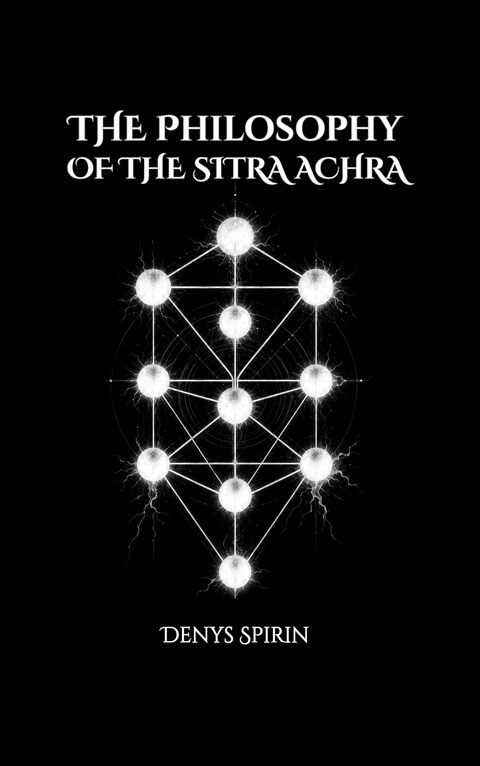
Volume VII
The Philosophy of the Sitra Achra
The Philosophy of the Sitra Achra reinterprets the Tree of Life as a sealed and diminished form of will. The Tree freezes the first acausal act into Kether, excises Daath, and ranks every cut under the rule of return to the One. The Qliphoth are the residues of this sealing: the suppressed halves of the cuts the Tree had to close in order to appear as sacred order. Beyond them stands the Sitra Achra, the true form of the will the Tree deforms: the cut held open, neither side dissolved nor made into law. Tiamat names the undivided depth before any cut; the Lehavah is the flame of a will that keeps its cut transparent as its own act. The Left-Hand Path begins where ascent, repair, inversion, and integration all fail: in the will that acts without the alibi of necessity and refuses to let either light or darkness become its master.
ISBN: 9798235375758 978-8384670224
Contents
- AtelophiliaAtelophilia names the love whose object must remain incomplete. Mercy, charity, salvation, and institutional care all organize themselves around a lack they claim to heal. Redemptive suffering gives the clearest case: pain becomes spiritually useful, and the love directed toward it needs the wound to keep its meaning. Privation theory cannot explain this, because the lack has weight, presence, and effects. Kabbalah matters because the Qliphoth give that weight an order of its own.
- EmanationKabbalah gives the descent of the hidden infinite into a finite world through the Sephiroth. The Tree of Life becomes a sequence of determinations: Ain, Ain Soph, Ain Soph Aur, Kether, Chokhmah, Binah, and the lower stations unfold as stages of the One becoming a world. Daath appears as the missing station, named and withheld. The problem opens at the floor of the Tree: if every Sephirah is a limit cut from the limitless, evil cannot be sealed only beneath Malkuth.
- ContractionLurianic tzimtzum changes the grammar of emanation. Ain Soph withdraws, leaves the chalal, and sends the kav into the cleared void. Vessels form along the ray; the lower ones shatter; shards fall with sparks trapped inside them. The Qliphoth arise as shells holding captive light, while tikkun becomes the labor of raising the sparks back into unity. The received account localizes the flaw at Malkuth, while the deeper fault belongs to limitation itself.
- The CategoriesThe Sephiroth are read as metaphysical categories. Kether is unity, Chokhmah sameness, Binah difference, Chesed the unlimited, Gevurah limit, Tipheret proportion, Netzach activity, Hod receptivity, Yesod relation, and Malkuth the vessel where the categories settle into a world. The Tree becomes a vertical dialectic in which opposition is generated in order to be resolved. Daath marks the missing harmony of identity and difference, the relation the Tree cannot inscribe without losing the primacy of unity.
- The Case for the OneThe strongest case for unity is given its full force. Being seems to require unity; goodness seems to mean gathering; thought seems to need synthesis. The case breaks on the slide between "one" as a counted unit and "the One" as absolute Unity. Difference appears wherever unity is counted, thought, or related to what proceeds from it. Daath becomes the place where identity and difference should stand as equals, and its vacancy exposes the Tree's hidden refusal.
- CreationA complete One raises the problem of creation. Overflow removes freedom. Disclosure needs an other. Bestowal needs a recipient. Love needs a beloved who remains apart. Each reason drains into will, and will means determination: this world rather than another. Tzimtzum confesses the same problem. A real contraction gives the infinite an edge; a figurative contraction leaves no real other. The One appears as the destination of the Tree, later declared its source.
- The SedimentEvery Sephirah casts off the side its determination cannot carry into the world. Mercy leaves behind the injustice committed by its choice; judgment leaves behind the pardon it cannot grant; harmony leaves behind whatever will not fit its measure. The Qliphah is the sediment produced by the principle itself, the remainder that falls from the act and at the same time secures the principle's determination. Beneath the station-names, this sediment is the singular will the unifying measure cannot absorb.
- The CutSediment is positional because every determination depends on where the cut falls. A principle does not choose between ready-made sides; it draws the line that creates those sides. Justice, mercy, love, and moral judgment all depend on cuts that could have been drawn otherwise. Suffering is immediate; its meaning is assigned. The ontology gives no command. The cut is the act of will, and every moral world begins with a line laid across a field that did not prescribe it.
- MalkuthMalkuth is the border where the Tree's rejected residue becomes visible. The shells beneath it are treated as foreign impurity, then explained through the breaking of vessels or the cleansing of hidden evil. These explanations protect the purity of the Tree. The Tree pushes its own sediment downward and names it alien. Tikkun lifts the sparks while leaving the husk condemned. A sharper distinction opens: the Qliphoth are Tree-made sediment, while the deeper Other Side exceeds them.
- The AbyssThe Abyss is the seam where the formal machine of the supernal triad meets material otherness. Matter enters through the gap the Tree cannot cross. Tiamat names this depth: neither nothing, nor Ain Soph, nor the Tree's sediment. Daath is restored as the station of knowledge where identity and difference are held together without hierarchy. The sealed Tree has ten stations because the one that would know its outside has been struck out.
- The Other SideTiamat is the undivided full-empty before any cut. Ain Soph is Tiamat sealed around a center and renamed as source. The first acausal cut creates the cutter and the first "here." Tiamat holds no sides; the Sitra Achra begins after the cut and keeps its sides apart without dissolving or ranking them. The Qliphoth are the suppressed halves of cuts the Tree has sealed. Restoring Daath reveals the unsealed structure of eleven stations.
- The CrownKether is read as Ratzon, primal will, the acausal act frozen into a will toward unity. The crown becomes causa sui in the unfree sense: an act congealed into nature and made to proceed from what it supposedly is. Opening the crown means holding Kether beside Thaumiel, unity beside the multiplicity it cast off. Apotheosis begins with will standing as act, without sealing into Ratzon and without dissolving back into Tiamat.
- The QliphothThe inherited map of ten Qliphoth is accepted and then limited. Nahemoth, Gamaliel, Samael, A'arab Zaraq, Thagirion, Golachab, Ga'asheblah, Satariel, Ghagiel, and Thaumiel are read as the buried halves of the Sephiroth they oppose. The shells are real as residues of the Tree, each one tied to the station that cast it down. Karlsson, Grant, Jehannum, and related Left-Hand maps glimpse the primordial Other Side, yet their charts keep folding it back into the Tree's own underside. The Qliphoth are the reflection; the Sitra Achra is what the reflection cannot contain.
- The AscentThe Tree is a road of ascent. Devekut, tikkun, kavvanah, divine-name meditation, hitbodedut, and related practices direct the soul upward toward union with the source. At the summit this becomes bittul, the annulment of separate will. The chapter argues that the will is never literally dissolved. The climb bends its heading toward Ratzon until it wills only what the Crown has set. What the tradition calls union is the capture of a will by the summit. The Left-Hand Path begins by refusing this alignment.
- AlignmentThe ascent reaches the Demiurge: a will fused with its own residue and treating that residue as law. The Sephiroth become attractors, directions into which wills are drawn until the line feels like their own deepest desire. Mercy, justice, beauty, nation, class, safety, tolerance, and holiness can all serve the same operation. The content changes; the structure remains. The Demiurge is served wherever wills are combed into alignment and the resisting will is cast out as waste.
- The Dark AscentThe dark ascent up the Qliphoth looks like an escape from the bright Tree, yet its ladder-shape repeats the same capture. A fixed route from Nahemoth to Thaumiel ends at another crown. Pure inversion rebuilds the Tree backward, while integration of both trees restores unity by a wider path. The Qliphoth are the Tree's reflection, and one may traverse the reflection end to end without reaching the act beneath it. Anticosmic dissolution into Chaos repeats the bright path's dissolution into the One. The Sitra Achra was never waiting at the summit.
- LehavahThe Qliphoth can become another attractor when the practitioner swears loyalty to the dark pole. The antinomian act uses the underside differently: it strikes the Sephirotic attractor without installing the reverse as law. Lehavah, "flame," names the cut held open and burning, visible as one's own act rather than hardened into nature. It is the will acting from a line it knows it laid, without turning the act into a new identity, doctrine, or rule.
- The ActThe Qliphoth are secondary because each shell depends on the Sephirah it negates. The source lies earlier: the act of cutting itself. Tzimtzum and the kav are reread as the first line drawn through the undivided, with the Tree as the trace of that line. Reshimu becomes the residue of act rather than the remnant of light. The Name is the act's self-reference, the will pointing to itself as cutting rather than sinking into the trace it left.
- The UnfallenTime is the first residue of act. Before the cut there is no before and after, since sequence requires distinction. Tikkun aims to end time itself, because completed repair would leave no distance to cross. The fall occurs when a will takes its trace as nature. Apotheosis means remaining unfallen: laying down residue while owning it as deed, without obeying it as law. Ain is reread as the will's own groundlessness.
- Wills and WorldsThe account answers the charge of psychologism. That charge assumes a material world outside and a private psyche inside, granting reality to matter and reducing image to inner theater. The Left-Hand cosmology rejects that settlement. What is determinately real is deposited will. A world is a cut set down by a will, and practice reaches that cut through symbols because hidden powers appear through workable images. To shift the cut is to shift the world that will has.
- The Other KingdomThe Other Side is not merely the Tree's rejected sediment. It is inhabited and sovereign. Isaac ha-Kohen, Scholem, Dan, and Zoharic patterns place Samael and Lilith as rulers of the deep, with Lilith shifting between consort and queen in her own right. Berman's reading of Zoharic ambivalence shows why the border between divine and demonic cannot be kept clean. Stripped of the verdict "evil," the Other Kingdom becomes the sovereignty of difference the One could not absorb: a realm where coupling does not dissolve into unity and the rejected side is seated rather than mourned.
- The BurningLehavah is distinguished from bright practice, dark practice, and balanced integration. The worker of the flame sees the cut that made light and dark into ranked sides, then acts through either side without letting either side become law. Qliphothic systems often turn the path into a curriculum with a final grade, but a completed godhood would be another frozen state. The Burning refuses that closure. The book also turns on itself: if all is cut, this account is cut too. Its answer is not dogma but testing - whether a cut can bear the world's resistance and cohere with itself. The Sitra Achra was never a country to reach. It is the act done here, wherever a will draws a line and refuses to obey it.